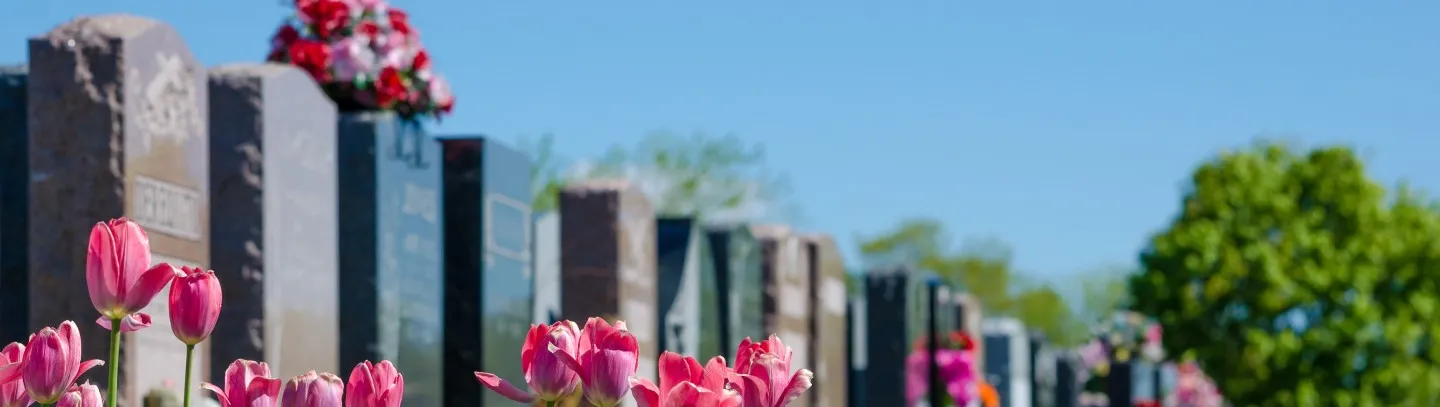
You might like to take a look at other memorials in the place of burial, as this will give you an idea of the shape and materials commonly used.
Things to consider when choosing a headstone:
- Timescale: Before erecting a headstone, the ground should be allowed to settle for at least nine months.
- Regulations: Crematoriums, churchyards and cemeteries have regulations governing size and type of material allowed. We can organise the approval process for you.
- Location: If under a tree or close to the hedge, a non-porous headstone like granite may be more suitable.
- Design: Even when considering only traditional shapes there is still a wide range available. Subject to any churchyard regulations, the choice is yours.
- Inscription: The wording on the memorial is naturally very important and should be chosen carefully. You may also wish to consider leaving space for a further inscription in the future.
- Carving: Memorials can be made even more personal by the use of carvings such as doves, angels, butterflies, foliage, etc.
- Lettering: Some materials suit certain types of lettering. For example, lead lettering should be only used for soft stones like marble. Gilded or painted lettering can be used on granite as well as stone.
- Maintenance: All memorials require cleaning to maintain their appearance and to avoid deterioration. Polished materials are usually easier to maintain.
Granite
Granite is the most durable, virtually maintenance-free and is available in a wide range of colours. Usually, the lettering is engraved into the stone and painted in gold, black, white or silver to stand out.
Marble
Being softer than granite marble is the best material for sculpture and carving. However, the porous nature means it will weather more quickly.
Stone
Because it is the most traditional material, stone and is more suitable for churchyards and their regulations. There is an endless range of textures and colours, which include York, Portland, Slate and Nabresina (also known as ‘Roman Stone’).
- IN LOVING MEMORY OF
- SACRED TO THE MEMORY OF
- IN REMEMBRANCE OF
- IN AFFECTIONATE MEMORY OF
- CHERISHED MEMORIES
- RESTING
- SLEEPING
- REST IN PEACE
- ABIDE WITH ME
- SIMPLY THE BEST
- IN GOD’S KEEPING
- THY WILL BE DONE
- PEACE PERFECT PEACE
- FOREVER IN OUR THOUGHTS
- NOT LOST BUT GONE BEFORE
- LOVES LAST GIFT REMEMBRANCE
- HE LIVES FOREVER IN OUR HEARTS
- GONE FROM US BUT NOT FORGOTTEN
- SO DEARLY LOVED, SO SADLY MISSED
- TOO DEARLY LOVED TO BE FORGOTTEN
- RESTING WHERE NO SHADOWS FALL
- THE LORD IS MY SHEPHERD I SHALL NOT WANT
- REST AFTER WEARINESS, PEACE AFTER PAIN
- ONLY GOODNIGHT BELOVED NOT FAREWELL
- UNTIL THE DAY BREAKS AND THE SHADOWS FLEE AWAY
- TO LIVE IN THE HEARTS OF THOSE WE LOVE IS NOT TO DIE
- GOD HAS YOU IN HIS KEEPING, WE HAVE YOU IN OUR HEARTS
- IN OUR MINDS A CONSTANT THOUGHT, IN OUR HEARTS A SILENT SORROW
- TO THE WORLD HE WAS JUST A PART, TO ME HE WAS THE WHOLE WORLD
- FATHER IN THY GRACIOUS KEEPING, LEAVE WE NOW OUR LOVED ONE SLEEPING